
2nd International Conference on Restoration. Aula magna, Palazzo Fenzi, Florence, from the debate of 06/12/1996. Session: Methodological aspects of conservation and restoration.
CRUCIANI*:
Can this Conference have a unifying effect?
D’ANGELO:
The best result one can hope for is that it will succeed in favoring a more efficient co-existence between those who are occupied with taking care of the monuments and doing conservation, and the increment of attention and of energy towards preservation. It is not our aim to attenuate the liveliness of the debate but rather to maintain it constantly. Society seeks itself continually and variously in art, in culture, and in the environment. For this reason it is necessary to preserve that which is considered part of the patrimony, but without confusing conservation with conservatism, and favoring research but without proposing a unique model or a unification of points of view. Only by consenting to the continuation of cultural pluralism, with respect to the historical life of the work of art, of the monument and of the environment with relative stratifications, is it possible to avoid forced solutions, confusions, and impoverishment. Obviously these general principles must be gauged according to the diverse sectors and the various contexts to which they are applied. A painting is very different from a building, as the building is from a piazza, or from a historical center. Changes of scale can upset the best proposals and many contradictions, evident in historical centers — as has been known for a long time — cannot and must not be confronted with anything but a lot of pragmatism. We must forget those surrogate theories which, with the excuse of increased modern sensibility, and with the enlargement of the ambits and scale of conservation, have pretended at all costs to deal with diverse scales and subjects through united diagnostics and therapies. ‘To be modern signifies to know that which is no longer possible’, said Roland Barthes. Too often the expressive potentialities of works of art have been reduced to a single poor reality which no longer allows them to be salvaged either visually or mentally. If function can contribute to the survival of a work of art, above all when this work has been projected to function – as with a building, a book or a weapon — it can likewise determine its demise, when it is imposed on painting, sculpture, and the decorative arts, or anyway wherever poor planning is applied. In historical centers, instead, the absence of function is always fatal. We must confirm without uncertainty the prerogatives of the document and of its capacity as a witness which science, from one day to the next, can multiply by ten. Thanks to parochial archives with the history of two families, there has just been individuated the gene which, when it becomes damaged, provokes Alzheimer’s disease. Who knows what it will be possible to read in the future by cross-breeding old and new data, if we should have the wisdom to preserve the documentary sources…
CRUCIANI*:
Is that to say that historical instances are to be privileged above aesthetic ones?
D’ANGELO:
I believe that the question can no longer be posed in these terms. Such an antithesis belongs by now to the history of conservation and of restoration but its true origin is found in an idealistic dialectical system that has been much too re-iterated. In the meantime let us clarify that works of art, fabrics or sites, once recognized as of relevant historical-artistic interest, be subjects to be respected and in no way should they become candidates for practical verifications of critical and theoretical hypotheses which by nature are neither stable nor universal.
CRUCIANI*:
Are you speaking of pure conservation or of conservative restoration?
D’ANGELO:
I would no longer speak of pure or impure conservation, nor of positions contrary or favorable to the co-existence of the old with the new, but of a projectual culture of conservation. The antagonism and the competition between extreme hypotheses, beyond some brilliant linguistic syntheses, normally do not allow the most reasonable choices for the subject to be safeguarded, which always has its specific peculiarities. And then many formal hypotheses, aesthetic if you wish, today are virtually verifiable. The most well known archaeological sites of Rome have been thus reconstructed; in some way they are visible and viable, but who would venture to truly reconstruct them?
CRUCIANI*:
It must be due to too much destruction but often one speaks of an identical reconstruction ( l’identique ). (1)
D’ANGELO:
Before proceeding, from more simple works of maintenance to the more exciting exercises of anterior writing (2), one would benefit from reading Borges’ Pierre Menard, author of Quixote. A very brief story that allows for frequent re-reading.
CRUCIANI*:
What do you mean when you speak of “a planned culture of conservation”; a professional keeping up to date, a scientific approach, or a theoretical study case by case?
D’ANGELO:
No culture progresses without science. To improve the conservation of historical architecture for example, it is indispensable to develop diagnostics and consolidation. But conservation is not a science; its procedure can be made partially scientific through the experiments in the laboratory and on the site. The consciousness, the confrontation, the dialogue and the choices presuppose however a broad culture and conduct based upon ethics. In order to conserve and preserve, a firmly ethical culture concerning the project for man is necessary, from the smallest artifact to the constructed and formalized environment. The conservation project must not present an interventionist execution but a meditated proposal to maintain the work of art or the historical fabric alive for as long as possible, in harmony with its identity and, as much as possible, with the present if that contributes to its preservation. In view of continuity, and in dialectical relationship with history, theoretically the project can come to include the new just as much as it can plan for a simple maintenance or a “non-intervention”. Casuistry with all its singularities is a fundamental reference but chance and the lack of cultural and ethical presuppositions do not allow the formation of principles and rules, even if one speaks at times of “case by case” approaches and methods. It would be as if one had to reinvent medical science at the manifestation of each new pathology. The specifics of each case instead strengthen the originality and the pragmatism of the project and, by consequence, its necessity.
CIARDI DUPRÈ**:
For the moment I can speak of a need that emerges from many reflections in my own field, but also from this conference, which has seen the convergence of so many aspects of restoration. Even keeping to this afternoon alone, we have passed from seismic problems to those of engineering and of the book. Then, had they taken part in the debate — and I hope they will come — the problems of medieval archaeology would also have been addressed: which is to say the vastness of the question and the need to take on ever new fields. We have seen the problem of the Jordanian settlements, which is a problem of archaeology but also different from many other aspects of archaeological research and of conservation restoration. Problems of a methodological nature, problems of philosophical enquiry into what the theme of restoration and conservation is — both of them ugly words, moreover, compared with the richness that lies hidden beneath them, of micro-histories and of macro-histories. So for the moment I shall set out my own idea: at the conclusion of these three days I feel the need to continue along this road, which is one of deeper enquiry into many fields. There are many choices to be made, and I hope that in the third Conference on restoration a great deal of space will be given to the decorative arts.
*Coordinator of the session Methodological aspects of conservation and restoration, 06/12/1996
**Coordinator of the session Training and teaching of cultural heritage, 04/12/1996
from the Proceedings of the 2nd International Conference on Restoration, 1996
Sources: echos magazine: www.echos.fi.it — www.conferenzaconservazione.it
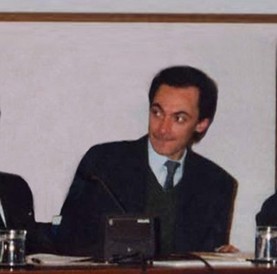
Enzo D’Angelo and Giuseppe Cruciani, with commentary by M.G. Ciardi Duprè