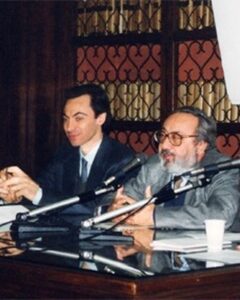
2nd International Conference on Restoration. Aula magna, Palazzo Fenzi, Florence, 06.12.1996. Session: History, restoration and art historiography. Dialogue between Enzo D’Angelo and Antonio Landolfi
ANTONIO LANDOLFI:
The past is indispensable, but how are we to look at it today?
ENZO D’ANGELO:
The nineteenth-century legacy of the past as a nostalgic realm of fantasy, with all its ambivalences, is still present, across the board, in every stratum of Western society. Nor is it merely a question of the failure — in itself no easy matter — of most of our contemporaries to keep pace with the problems of art, of aesthetics and of the thought of our century. If, as is obvious, one can neither hope for a univocal reading of the past nor for its reinstatement in place of the present, the «Eros of distance», to quote Klages, is still very much alive, together with its susceptibility to manipulation. The past and its monuments have lain at the root of the emphasis on nationalisms and of functionalist adaptations, with a great many ideological manipulations.
ANTONIO LANDOLFI:
Do you see functionalism as being close to dictatorships?
ENZO D’ANGELO:
In part, if we are referring to the Modern Movement. But we cannot forget the losses caused by adaptations to the symbolic and celebratory functionality of strong regimes — from Napoleon III to Ceaușescu — with the gutting of historic centres, the creation of ceremonial avenues, the restorations and the projects of cultural endorsement, with the search for classical testimonies to the detriment of Baroque and medieval ones. Just as we cannot forget the ambiguities of the universal functionality of the Modern Movement itself, with the rationalist utopia of an architecture that was the repository of equality and truth, capable of unifying peoples. In this case too it was a matter of an ideology which, like the dictatorships, ended by ignoring stratifications and differences — that is to say history, identities and cultures — reducing, through a totalising leap of scale, the demands for renewal to uniformity. Thus, even from opposing premises, significant presences and artefacts of the past and of the present have often been sacrificed to the requirements of a global industrial civilisation bent on optimising its production, either destroyed or adapted by means of convenient mystifications. In historic cities the internal and external maskings of surfaces, materials and structures are beyond counting. The panorama then includes post-war reconstructions that are not always beyond dispute, the so-called development of building speculation, the destruction of many landscapes … why should we be surprised at the widespread disorientation, at the estrangement and at the flight into the past?
ANTONIO LANDOLFI:
Does this not go some way towards justifying nostalgia? What sense can there be in the idea of the past as the destination of a flight?
ENZO D’ANGELO:
Without forgetting that, before it dissolved as a pathology and underwent its semantic erosion, nostalgia had a clinical history parallel to that of the city and of modern town planning — and how difficult it is, with hindsight, to maintain that the problem did not exist — we shall obviously have many misgivings when faced with regret for what has never been known. But if there is a Sartrean désir de rien, there is also the unease in the face of the irreversibility of time, which the loss of testimonies and the absence of history make more acute. Nor does it matter whether nostalgia is a variant of melancholia or its final stage. I think of Benjamin’s angel of history, who looks upon the ruins of the past but, his wings held fast, is driven by the storm towards the future. In the no man’s space-time in which we risk finding ourselves suspended, while we are also plunging into the future, we must accept change by looking back but without regrets. Flight is desirable if by it we mean the capacity to react and to set responses in motion; to formulate, as in music, a thematic paradigm in which different voices coexist or, geometrically, the meeting place of projections. It is not desirable if by flight we mean self-exclusion, the abjuration of the present or of its historicity.
ANTONIO LANDOLFI:
When flight leads to a place or to a time in the past, does it not bring us to utopia and hence to an ideology?
ENZO D’ANGELO:
Today the tendency is rather to flee ever further into the future by way of virtual reality, hyper-communicability and simultaneity, relegating to second place the original text, the document and even narrativity — that is, the scansion of the literary, artistic and architectural text, which allows us to read it and to commit it to memory. The conquests of technology draw us away from the objectivity and the physicality of the present, turning a time still to come into an ideology and devaluing the practicability of the hic et nunc.
From utilitarianism to mono-functionality: a process of absolute reduction determined by the ideologisation of science and technology, which in the end excludes principles and critical and communicative activity. Habermas had already described it very well in the nineteen-sixties with his critique of ideology.
As for the consecutiveness of utopia and ideology, if we know them to be complementary we also know how the former, for all its statistical weakness, is the strongest alternative to the latter and indeed, precisely by virtue of that strength, has provided legitimation for ideological impositions. Of both we reject the authoritarianism and, in any case, the various levels of these concepts must be taken into account, as much for their linguistic as for their historical or philosophical usage.
Ideology, which for Condillac and the sensationalists defined the formation of ideas, has by now been reduced, at least in Europe, to designating their crystallisation. Contrary to manipulative use or to emphasis, to exclusivism or to racism, the capacity to idealise and to bring together through ideals is a positive one.
Of utopia, beyond its power of social and intellectual fascination, we cannot ignore the imaginative and liberating capacities. And when Ricoeur credits it with the function of maintaining the gap between hope and tradition, since «to imagine the no-place is to keep the field of the possible open», he brings us back to the «principle of hope» and to the related ontology of Ernst Bloch. Bloch’s «concrete utopia» offers us the Aristotelian potentialities of matter with its «hunger for forms», a progress made of plurality and difference and a nature «which is not a past, but the building land», inviting us to the project or, for the time being, to the meta-project of a periphrasis by which I would say that the past is a natural form of culture as against the organised form of history. There remains open, however, the problem of historiographical models after the crisis of unitary theories and of the philosophy of history.
ANTONIO LANDOLFI:
The crisis of the idealist philosophy of history has been apparent for many decades now. It goes back to the historiographical revolution of the Annales. In Italy, the overturning of the neo-idealist position culminated, as early as the beginning of the nineteen-sixties, in the debate aroused by Eugenio Garin’s essay La filosofia come sapere storico. This whole upheaval, with the changes of course it has brought about in historiographical approaches, has nevertheless stimulated historiographical research and in particular specialised research. Once neo-idealist monism, and what had become its counterpart — namely Marxian materialist monism — had been interrupted and superseded, historiographical research succeeded in deploying its energies, directing itself towards various objectives, articulating and branching out into specific fields: from economics to custom, from linguistics to popular traditions, from science to art and landscape; from the social sciences and institutions to cinema, photography and the visual arts. This new path of historiographical research, already heralded between the two wars by Huizinga’s reflections, sets out — as Falco wrote — to tell «how things went» without carrying us off «into the rarefied atmosphere of speculation (…) so that the language of facts may at the same time be the language of ideas». Throughout this orientation there echoes the lesson of Vico, in the Scienza nuova, according to which history is nothing other than the understanding «of the very manner in which things came into being». The impulse given by the new orientation to specific historiographical research, while leaving open infinite problems of method and of meaning, of the relation between specificity and universality, has opened the way to historiographical work in manifold fields, among which the foremost is that of the real, visual, urban and artistic setting in which cultures and ways of life took concrete shape, and in which events unfolded at each single moment of history.